Oak:  smoke, toast…vanilla?

Wine makers and wine drinkers love to talk about oak.  And given that oak-use is incredibly complicated, it is not surprising.  Oak barrel fermentation, aging in oak, the flavors that oak imparts, the amount of oxidation you get through the porous oak barrels, the type of oak that is used – American, French, Slavonian – and the size of the barrels not to mention the discussions of how the barrels are made and who makes them.  It is all fodder for both professionals and enthusiasts.

Let’s break it down a bit first.  The first use of oak is said to have been a Roman “discovery.”  In ancient times, in Mesopotamia and Greece, there are written accounts of people using palm wood to transport wine.  However, because palm wood is hard to bend for barrel-making, the Romans had begun using clay amphorae – until they spread to Gaul in what would one day become France.  There they noticed the Gauls using oak barrels held together with metal bands to transport beer.  It became obvious to the Romans that transporting wine in wood rather than clay would save a great deal of wine from destruction.  

Oak was particularly favored for barrel making because it was plentiful in Gaul and was relatively easy to bend to the barrel stave shape and could be toasted to impart certain flavors and textures to wine.  Over a short period of time, the Romans realized that oak made wine softer and smoother and more aromatic, and the rest as they say, is history.   

These days, oak barrels are made in cooperages, and each cooperage imparts its own unique character to its barrels.  The staves are made with freshly cut or split oak beams.  American oak is less dense and can be cut to size while French oak, which has a tighter grain, must be split.  In the most traditional (aka, “best”) cooperages, the staves are left out in the weather for a few years to “condition.”  A modern cooperage will kiln dry the wood.  Then the staves must be heated to bend them into the characteristic shape for a barrel before being roasted over fire for the desired amount of “toast”.  The amount of toasting is very important because it determines the flavors that are imparted to the wine.  The darker the toast, the more coffee, burnt sugar and even smoky flavors.  Less toast offers vanilla, coconut and baking spice aromas.  Furthermore, there are differences in the flavors imparted by French and American oak, with French oak naturally having more hazelnut and smoky aromas and flavors while American oak imparts coconut and butterscotch.  A good cooperage will be able to work with the vintner to determine what exactly what type of oak and toast the wine needs and will be able to make the barrels to exacting specifications.

So what does oak do for wine?  It is slightly different for white and red wines.  In white wines, oak tends to lend a more delicate flavors and fewer tannins.  The oak itself has tannins that bind with the proteins in the wine, so whites do not become more tannic with oak fermentation or aging.  Red wines on the other hand, already have tannins that have bound with the proteins in the wine.  That means that non-neutral oak generally imparts more tannins to red wines than they have naturally.  So, in addition to the vanilla / caramel / butterscotch types of flavors in American oak and the more coconut / hazelnut / smoky flavors in French oak, red wines tend to become more structured in oak barrels.  Initially at least.  Over time, oak is permeable to small amounts of oxygen.  This slow process of oxygenation allows the tannins in red wine to form chains and become smoother and more textural, rather than drying.  

Aging wine in oak is expensive for many reasons – the barrels are costly, they allow the wine to evaporate and need to be topped up regularly, it is hard to keep the barrels clean, they need more careful handling in the winery and so forth.  So, most wines that are stored in oak are high quality wines.  However, there are certain less expensive wines that boost oak flavors in the wine by adding oak chips or staves to wine – and these wines are often over-oaked and are dominated by the oak flavors rather than the flavors of the grapes.  

It has been my observation that some people love oak flavors in wine – hence the popularity of California Chardonnay for example – and some people love wines with no oak – like Chablis much of the time.  It is something you, dear reader, will have to disambiguate for yourself.  Either way, cheers!

Nothing dry about Dry Creek Valley

Sonoma County, 90 minutes north of San Francisco, is gorgeous wine country.  Picture rolling, lush green hillsides covered in orderly and beautifully twisted head-trained vines interspersed with aspens, sycamores, wild grasses, flowers of all colors and herbs of all fragrances.  If you are lucky, you will also see some sheep and chickens in the vineyards that add a bucolic, painterly vision of cultivation.  Driving through the winding roads, you roll down the windows and smell the fresh air as if it is something that reaches into your lungs and blows wonder into your every pore.  

The morning temperatures are cool and breezy and perhaps a bit foggy.  The perfect temperatures to put on a sweater, drink some hot coffee and set off on a day of exploration for the senses.  The afternoon warms you up just enough to sun your face, go for a bike ride, skip some stones over a lake, take a picnic blanket out to a field and enjoy the bounty of the land around you.  And the evenings…are slow as molasses.  Breathtaking shades of peach and lilac drift through the sky as the sun sinks lazily past the horizon, bringing that hint of chill, making you want to reach for your favorite bottle of zinfandel – or will it be cabernet tonight?

I am describing my trips around the Dry Creek Valley (DCV) of Sonoma Valley, alas from before the pandemic and some of the devastating fires.  I miss it so much because I have never felt more whole as a person than I felt there.  Life seems beautiful and simple out in the fields.  People work hard, they grow the grapes, they make the wines and sell those beautifully labelled bottles full of dark magic. They enjoy the serenity of the wide open spaces and respect their lands and their heritage.

DCV is a small 16 x 2 mile viticultural area where you’ll find two roads, five stop signs but no stop lights, and 9,000 acres of mostly family owned farms.  And it is not actually dry – it has simply been dammed up so that the flow of water has been reduced, but it is still a tributary to the Russian River.  And the water provides cooler soils closer to the river and warmer soils farther up the banks, but provides enough water for the farmers to “dry farm” their grapes. It lies between the cool Russian River Valley to the south and the warmer Alexander Valley to the north, providing another axis of cooler and warmer terroir.  It is cooler in the south because it receives cool Pacific fog and breeze through the San Francisco Bay and warmer up north as it enjoys more clear skies and sunlight. 

DCV is most well-known for its robust Zinfandels.  Don’t be led astray by the sweet, old-fashioned “white zinfandels” of the previous century.  Zinfandel is a red grape, identical to the Primitivo grape of Italy and a more obscure grape Croatian grape called Crljenak Kaštelanki.  Cabernet Sauvignon, being a more sought-after variety, has sometimes caused grape growers to switch from Zinfandel to Cabernet, but there are still many old vine Zinfandel plantings to be found – anywhere from 30 to 100 years old.  As consumers have begun to understand that Zinfandel makes very good wines, the interest in preserving these old vines and planting new ones has increased in recent years.  And the wines are full of brambly black fruit – plums, cherries, berries and currants with spices and a bit of tea leaf on the finish.  Early ripening with more manageable tannins and plenty of body, the struggle now is to make enough of it for the current market.

If you are feeling thirsty for some Zinfandel, some of my favorite wines from DCV are made by Ridge’s Lytton Estate, Raffanelli, Seghesio and the eponymous Dry Creek Vineyard.

Learning to love wine

Does one drink wine in a cozy, wood paneled old pub? Surrounded by flowerboxes at a sidewalk cafe? In a very elegant dining room? Or on a picnic blanket out in a field of grass?

I’ve been thinking about mood and place and company lately. In graduate school, when I was studying political economy, I literally had this picture in my mind of spending afternoons at very artsy, bohemian cafes, wearing all black and discussing Hegel and Heidegger over some rot gut wine, like Hungarian Bull’s Blood from Eger. Of being passionate and being with passionate people who wanted to solve all the world’s problems deep into the night.

Then I entered the real world: a job, a little more spending money and a regular schedule of 9:00am meetings. I still socialized quite a bit but I was not as idealistic or extravagantly carefree. Coming from a not wine-friendly culture like India, I tried to like beer, I did like cocktails but not the headache afterwards and I occasionally drank wine. Those were the heady days of over indulgent Australian Shiraz and wonderful, cheap Portuguese wines whose names I couldn’t pronounce, but which were big and jammy and highly extracted.

At some point, I realized, I was beginning to like wine for more than just that jammy fruitiness and I realized, I have no idea what is even in a Cotes du Rhône!  What grapes are in Rioja or Chianti? Those were the days of course before apps and blogs, and data charges for cellular internet were expensive. Most shops and restaurants did not have WiFi and information was not as freely available as today. So educating myself had to be very intentional. 

More to keep pace with my much more wine-savvy friends than for any other reason, I enrolled in my first wine course at Boston University.Taught by 2 Masters of Wine. I had no idea how privileged I was. And it was fabulous! I had finally found my passion. It took a few years to get back to it.  I had to realize that I wanted to change career paths—but since then, I’ve taken 6 more courses and a few Master Class trips to Sicily and Tuscany through BU, plus various other courses through the Wine and Spirits Educational Trust (WSET). And in spite of all those classes, the learning never stops!  It is a huge world of not just wine tasting—in fact that is almost the least of it—but also history, culture, soils, climate, grape varieties, wine making techniques, business models and more.

So now, today, how do I think of wine? It is bifurcated. I have my more analytical mode—in which wine is more of a puzzle to be deconstructed and examined from all angles. And there is the I’m-switching-off mode when it is about pure enjoyment —an enjoyment that really is enhanced for me and hopefully those with me in knowing what about the wine stands out or rates notice, knowing perhaps something about the varietal character, history or a story about the producer. It is a luxury to lift a glass, look at the color, smell the bouquet and savor the palate and know what you’re doing. But it is also a simple pleasure—choose what you like, choose what you eat with it and choose your companions carefully! Life is short. Santé! 

What’s so special about Bordeaux?

I have never been to Bordeaux. Given that it’s almost always the very first area one studies in every wine course, I have always taken it as a personal failing. But one doesn’t always have to go somewhere to learn about the wines or love them. Especially in a place as complex and historic as Bordeaux.

Bordeaux wines, also known as “Claret” in the UK, has been an important import to the British Isles since Eleanor of Aquitaine married Henry II in 1152 CE. Back then, Bordeaux was not a producer of wine but rather a distributor of wines, often from Gascony. Over the centuries, as Aquitaine passed from British rule to French rule, came under the influence of Dutch merchants and then back under the British, the Medoc, Haut-Medoc and Graves or the Left Bank wineries established a reputation for making coveted, high quality wines. This took place over several decades between 1660 and 1720.  In the years following, from 1750 until the late 1790s, the Right Bank began to be recognized as a great wine region as well. Fronsac-Canon and then St. Emilion established themselves, followed later by Pomerol.  

The big event for Bordeaux happened in 1855.  When Napoleon III decided to host a World Exposition, he asked the Chamber of Commerce to organize a wine exhibition. The Chamber turned to a group of Bordeaux merchants called the Syndicat des Courtiers for help listing all the wines of the Gironde and their classification by quality. The Syndicat in turn, presented a list of all 58 wineries in the Medoc (not Graves or the Right Bank) “ranked” simply by price. It caused a great deal of controversy at the time. However, while changes have occurred in the past 170 years, the classification still stands today in many of its specifics.  

Bordeaux wines in general are meant to age and be drunk when their ferocious tannins have mellowed and all the oak and fruit has integrated into a harmonious, luscious whole. The Left Bank tends to need more aging than the often more fruit-forward but powerful Right Bank wines. This is because the terroir of the Left Bank supports cultivation of Cabernet Sauvignon which ripens later with stronger tannins, and the terroir of the Right Bank better supports growth of Merlot and Cabernet Franc, which ripen a bit earlier and can be a bit softer.

Essentially, unlike Burgundy, Bordeaux wines are blends – with the 3 primary varieties and 3 minor partners.  Cabernet Sauvignon, Merlot and Cabernet Franc, then Malbec, Petit Verdot and Carménère. The famous Bordeaux blends exist because of the variability of vintages in the region, which often require adjustments to the blend based on which grapes fared best during the temperamental growing season. Sometimes, if the Cabernet Sauvignon struggled, wines will rely on more Merlot in the blends to soften the austerity of the resulting wine. Sometimes in a more ideal growing season, the wines might be more Cabernet Sauvignon dominant because the grapes ripened perfectly.  

Many Chateaux in this way rely on their ability to blend to create a “house style.” For example, Margaux is called “elegant” while Pauillac referred to as “powerful.” It is largely because winemaking is an art and the artist works with his palate of grapes to create unique works.

In Defense of Wine Speak

I am sure every discipline has its share of navel gazing. Perhaps more in the wine industry than in others. For example, when we use words like “linearity” or “searing” or “stiffening the mid-palate.” Sometimes even I, after seven years of intensive study and work, am not sure what people mean when they say these things. And it is hard to get away from the idea that some of the language is simply pretentious. But bear with me.

Consider the challenge. We have a limited vocabulary to express flavors, smells, textures in the mouth and overall enjoyment. Most wine drinkers fall back on a rote list of descriptors such as fruit, flowers, herbs, minerals and sweeteners, with a few other modifiers such as smoke, leather and earth. This limited range of adjectives often does not convey the entire experience of tasting a wine because it is simply too difficult to encapsulate a sensory journey.  

But smell and flavor are so intimately entwined in our memories and experiences that we must often struggle to find the right descriptor. If I say “tamarind,” will you know what I mean? If you say “nettles,” will I know what you mean? As in many professions, Wine Experts need to be able to speak to a very broad range of people with a very broad range of tastes, backgrounds and preferences. And again, as with many professions, we need to be able to speak both technically to our peers and use more accessible language for laymen and enthusiasts. (Un)Fortunately, we have settled on a set of common terms that make sense to most people.

However, flavors and aromas are not the only important aspects of wine. Describing wine accurately also requires using some more arcane terms to convey such facets as the body, texture, complexity, intensity and overall balance of a wine.  In technical terms, these last five aspects of wine are often more important than the nose or palate. Grape varieties bring their own special magic to wine—that is why we use so many different types of grapes. And the process of making wine—using wild or cultivated yeasts, temperature of fermentation, length of time on the skins, aging in oak or stainless steel and so forth—also brings different smells and flavors to bear. But it also affects those other five factors and, in some ways, those are the more important parts of the wine for us.

So…does the wine feel silky smooth? Chalky? Viscous?  In which part of the mouth do you feel these sensations? Does the wine make your mouth dry? Or does it make your mouth water?  Does it linger pleasantly on your palate? Examining all these aspects, in short, is complicated. You want to give your customer just enough and not too much information. You want to talk about the wine in a way that genuinely conveys its full goodness but not overwhelm the reader or drinker.  And you want to give enough guidance so the listener can appreciate the history of winemaking or location of where the wine comes from, which always makes it more interesting and enjoyable no matter whether you are a novice or experienced hand.   

So, if some writers or sommeliers use language that is too ornate or go on at length about the wine’s “ethereal quality” or its “finesse,” bear with them. Appreciate their enthusiasm because often the more they have to say about a wine—pretentious sounding or not—the more they appreciate where it comes from, who made it, why it is special and how much you might enjoy it.

Paris in November

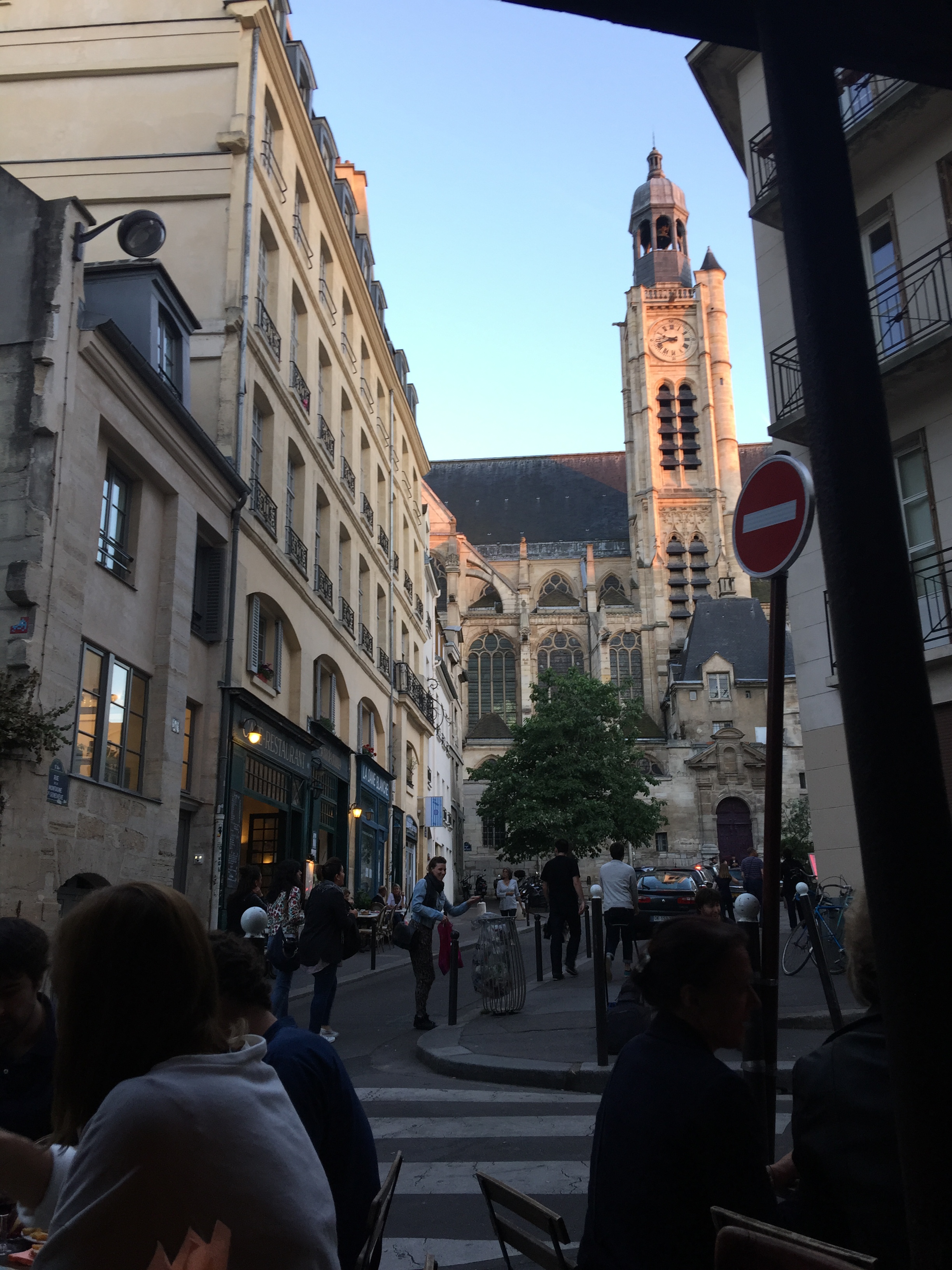
The weather has been gray and drizzly with periodic wind and rain.  And  it has been cold.  But even with this dismal inauspicious weather, Paris is just a magnificent city.  The dull light makes the shops sparkle that much more, the smells of baking bread and roasting chickens that much more enticing.  It makes the cafes – even now with their outdoor tables and outdoor heaters under the awning seem so cozy.

There is very little about this city that I don’t love.  I feel alive here in a way that makes suburban Boston sort of deadening.  I love my life in Boston – Arlington to be precise.  I have a gorgeous house that is perfect for our family, wonderful friends, a car mechanic who is a amazing, a hairdresser I love, good schools for the kids, lots of fun things to do… But Paris!  5 outfits, 2 kids and 0 cars.  That is about all I need.

Our apartment is on the Quai des Celestins.  Just the name of our street gives me a little thrill.  Our celestial abode.  It fronts onto the river and the east end of the Ile St. Louis.  If you walk across the bridge, you turn down this narrow little street which is the main street down the island and you run into the most amazing street life.  Tourists and Parisians walking, chatting, honking, shopping, eating Bertillion ice cream in amazing flavors like prunes and armagnac.  You go a little further until the end of the street and you find the most amazing shop with vintage Louis Vuitton and Hermes bags, Eames chairs, etc.  A little further, cross the bridge onto the Ile de la Cite and the breath will leave your body.  The vista opens up on the back of Notre Dame Cathedral.  It is the most beautiful sight in Paris, in a city full of wonder.  The flying buttress are delicate and airy.  The moss that softly colors them makes them look like something out of a children’s fairy tale.  The spires are so tall and elegant, you squint to see the figure at the top.  The trees hide any sign on modernity and you can imagine what it must have been like 800 years ago.

This year is Notre Dame’s 850th anniversary.  As we were walking through, a docent probably noticed we did not really fit in – I am not sure how.  Even at this time of year, there is a line of tourists waiting to enter and the pews are full of people gazing up at the rose windows in awe.  But she still spotted us.  She asked if we believed in God.  With all my decades of maturity, I sort of gave a nervous giggle.  I am Hindu though I don’t practice I told her.  Rather than say Gunnar is an atheist, I told her that he does not practice (what?) either…But she was just curious.  She told us more about the cathedral in 5 minutes than we had learned in maybe 20 previous visits.  Even in the olden days, the church was crowded with pilgrims and worshippers.  In order to have some peace, the monks built an internal quiet space with high walls to pray and decorated the outside with scenes of the life of Jesus.  The panels are all carved in stone and painted in bright colors and gold leaf.  It was meant to be an educational experience, to have a visual reference for the stories of the bible.  It reminded me of how we try to teach our kids even now – bright colors, simple stories, incidental contact that allows them to learn at their own pace.  🙂  She also told us the windows are built so high and all the statues are raised because in normal life you look down and around you.  Here you are reminded that God is above and that you should look up and behold his wonder.  But of course, Notre Dame, as the name states, is devoted to Mary – so perhaps it is to behold her wonder.

(For nonbelievers, we spend a lot of time in churches here in Paris.  I love the cathedral of St. Genevieve – she is the patron saint of Paris, supposedly having diverted Attila the Hun from sacking the city through her prayers and devotion.  It is the baby church next to the massive Pantheon – delicate, exquisite and very beautiful.  We also always go to St. Sulpice.  we have been there countless times – it is conveniently next to the Marche St. Germain and near the Luxembourg Gardens.  But I still have no idea who St. Sulpice is.  Perhaps the docent will come there someday and explain it to us.)

But Paris is somehow the city of my heart.  I am not sure others understand – maybe my sister – who also has the heart of an explorer and free spirit despite her engineer’s brain.

I wonder sometimes if it is not the absolute anonymity of being in one the great cities of the world.  Is it that I have absolutely no real responsibilities here?  That there is no pressure to socialize, to behave in any particular way, to conform to life as I have to in Boston?  Is it just that here I can escape?  Or, is it that it is just so beautiful?  Even if you have walked down a street a dozen times, you will still find something new and lovely to see.  And really, I love Parisians.  More than not, they are pleasant, funny, helpful.  And most want to practice their English it seems.  They don’t even give me a chance to practice my French – which I doggedly do anyway!

In any case, it is as always, so wonderful to be here.  The Christmas decorations are going up, the markets are gearing up for the holidays.  The Champs Elysees has been illuminated and it all looks festive.  I have a feeling we will be going home with lots of christmas junk this year!  🙂