

When I began studying wine several years ago, I really just wanted to know the difference between a Rhone and a Burgundy, a Napa Cabernet and a Bordeaux. I did not have any grand ambitions. However, as I progressed through the classes, I realized that wine brings so many subjects together – you pore over detailed maps to memorize appellations; you have to learn the different character imparted by schist or slate or loam or limestone; you have to study how many hours of sun each zone averages to know which grapes are likely to ripen well or over cook in certain areas. You have to smell your way through the world – what is the difference between black berry and black currant? What do acacia or hawthorn smell like? Can you distinguish the differences between lemon, lime and grapefruit smells? Or apples, pears and quince? You also taste your way through your kitchen. How do you judge the amount of mouth-drying astringency in something? Or if sourness and sweetness really do offset each other? When a sommelier says “structured,” what does she mean? Or smooth, or searing, or chalky or velvety?
It is astounding how complicated the process of learning about wine can be. Wine is a second career for me – in my previous life, I worked in international development and traveled to Mali and Malawi, Albania and Macedonia, India and Indonesia, Nepal and Mongolia. And yet, I find my intellectual engagement in wine to be just as immersive and fascinating.
Perhaps the most important thing I have learned is that wine is best enjoyed when you just … enjoy it. It need not be complicated or challenging or an acquired taste. Most professionals poo-poo a big heavily-oaked California Zinfandel or a jammy, wonderfully chewy Shiraz from Australia. But sometimes on a cold winter day, it is the ultimate relaxation to curl up with the comfort-food equivalent of wine, palate-fatigue be damned.
In that same vein, many people have become wary about wines that are sweet. We have all suffered through a flabby Moscato or an overly fragrant, soapy Gewürztraminer occasionally. But that should not put one off appreciating a truly fabulous off-dry Riesling or a wonderful, slightly sweet Vouvray. The key is to find a wine with balance. Sweetness in a wine can be elevated to greatness with tartness from both tartaric and malic acid, with yeast contact that imparts a bready set of flavors and through aging, which allows all the floral, fruit, pastry and mineral flavors to blend into something gorgeous. In fact, some of my most memorable experiences with spicy Indian or Southeast Asia food involved a bottle of German Riesling. And some of my favorite dessert wines are not the sweet fortified wines of port or madeira, but rather with the sweeter expressions of Chenin Blanc.
Therefore, I urge you. Don’t be afraid! Challenge yourself to try a well-made, well balanced sweet wine. With flavorful cheeses, garlicky-salty charcuterie, strongly flavored cuisines and even simple meals, it can be the perfect storm.
Category Archives: Uncategorized
Pinot, pinot, pinot!

I often hear people refer to the wine they are drinking as “Pinot” – but since “Pinot” comes in red, rosé and white, not to mention sparkling, one should disambiguate! Is it the blanc, the gris or the noir? What does “blanc de noir” mean? And what is the difference by the way between “gris” and “grigio”?
Today, we will explore all of these questions.
The word “Pinot” is thought to refer to the shape of the grape bunches on the vine because they resemble pine cones. They have relatively small berries which are tightly packed together in a characteristic shape. And, given all the names attached to the word “Pinot,” one might be forgiven for thinking that they refer to a family of grapes. In fact, all the pinots share a genetic fingerprint. Or in other words, they are all clones or mutations of one variety. The gris and blanc are just lighter skinned versions of the noir. Much of this is because the pinot grapes have been around for centuries; some think they have been around for 2,000 years with specific references dating back to the 4th century A.D. It has had a lot of time to create a highly branched family tree.
The expressions of the various wines span a spectrum of colors, styles and flavors. Pinot Noir is the red wine made anywhere from a light, fruity easy drinking style full of bright cherry and strawberry notes to a more muscular, grippy style full of forest floor and earthy, meaty aromas. Most interestingly, it can be made into white sparkling wines, called “blanc de noir.” This literally mean “white from black” and is made by very gently pressing the grapes to ensure that color from the skins does not leech into the wine, which is then fermented as a white wine.
Pinot Blanc wines tend to be made with white grapes into a white wine (obviously) but they are often made in a relatively full-bodied style with moderately aromatic characteristics of stone-fruit, almonds and grapefruit. It is most widely planted and highly regarded in Alsace, France, Germany, Italy and Austria. Unfortunately, in most other regions of the world, it is woefully under-appreciated and does not receive the attention it deserves!
That is not the case with Pinot Gris or Grigio, which has seen a huge rise in popularity of late. So, what is the difference between the two? It is pure style, baby. Pinot Gris is the French / Alsatian name which also denotes a rounder, softer, fuller-bodied, more scented style. Pinot Grigio is the Italian name and also the Italian style. A bit harder-edged, a bit sharper with higher acid and crisper finish. Both can have beautiful noses with stone fruit and grapefruit with a hint of orange blossom. Interestingly, different places in the new world have adapted both the names and styles to some extent. In Oregon for example, the viticultural area rules prohibit calling it “grigio” and one might expect a more Alsatian character to the wines. New Zealand also hues to the “gris” name and style. But Washington and California tend to call it “grigio.” Go figure.
Learning to love wine

Does one drink wine in a cozy, wood paneled old pub? Surrounded by flowerboxes at a sidewalk cafe? In a very elegant dining room? Or on a picnic blanket out in a field of grass?
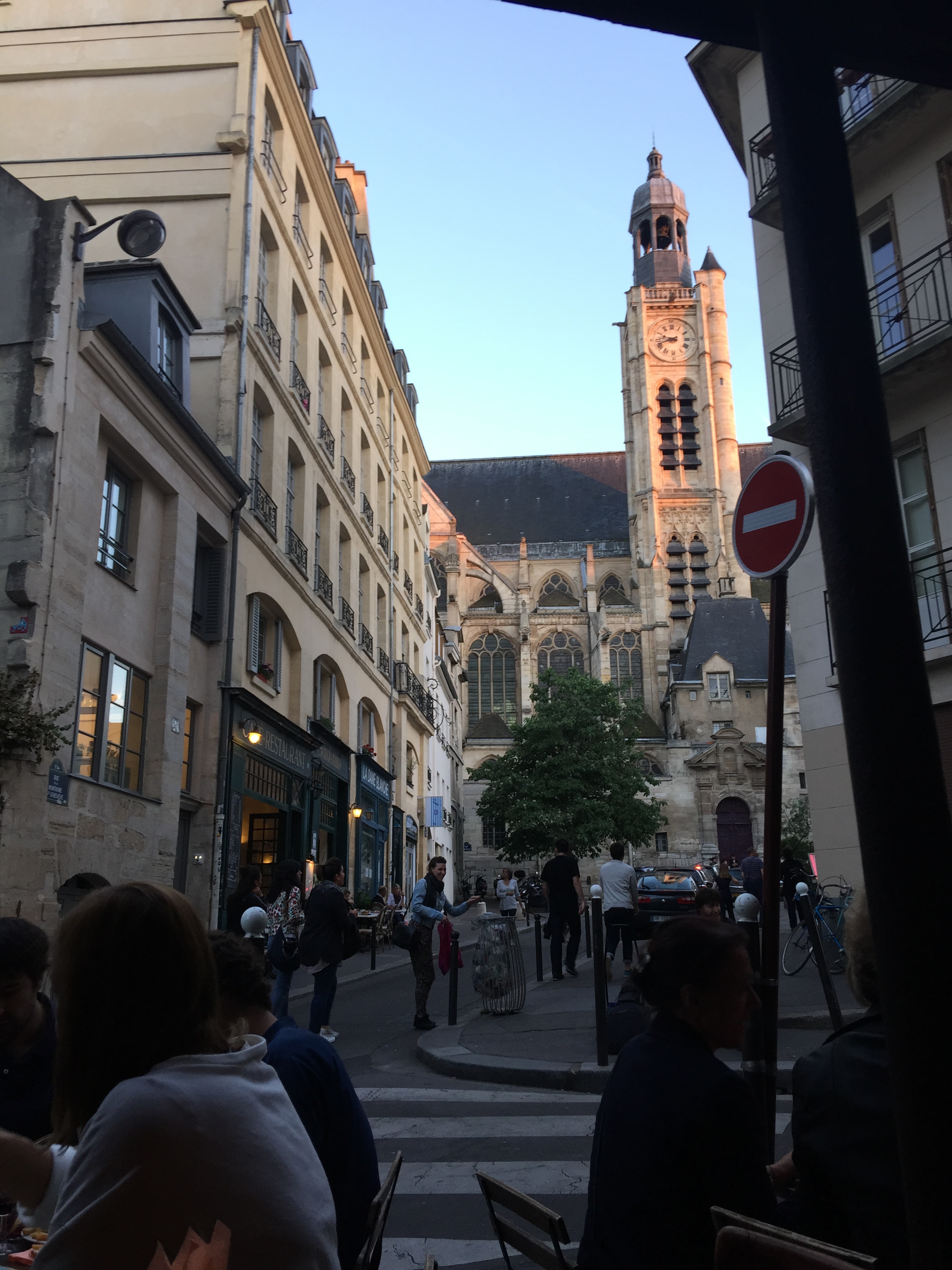
I’ve been thinking about mood and place and company lately. In graduate school, when I was studying political economy, I literally had this picture in my mind of spending afternoons at very artsy, bohemian cafes, wearing all black and discussing Hegel and Heidegger over some rot gut wine, like Hungarian Bull’s Blood from Eger. Of being passionate and being with passionate people who wanted to solve all the world’s problems deep into the night.
Then I entered the real world: a job, a little more spending money and a regular schedule of 9:00am meetings. I still socialized quite a bit but I was not as idealistic or extravagantly carefree. Coming from a not wine-friendly culture like India, I tried to like beer, I did like cocktails but not the headache afterwards and I occasionally drank wine. Those were the heady days of over indulgent Australian Shiraz and wonderful, cheap Portuguese wines whose names I couldn’t pronounce, but which were big and jammy and highly extracted.
At some point, I realized, I was beginning to like wine for more than just that jammy fruitiness and I realized, I have no idea what is even in a Cotes du Rhône! What grapes are in Rioja or Chianti? Those were the days of course before apps and blogs, and data charges for cellular internet were expensive. Most shops and restaurants did not have WiFi and information was not as freely available as today. So educating myself had to be very intentional.
More to keep pace with my much more wine-savvy friends than for any other reason, I enrolled in my first wine course at Boston University.Taught by 2 Masters of Wine. I had no idea how privileged I was. And it was fabulous! I had finally found my passion. It took a few years to get back to it. I had to realize that I wanted to change career paths—but since then, I’ve taken 6 more courses and a few Master Class trips to Sicily and Tuscany through BU, plus various other courses through the Wine and Spirits Educational Trust (WSET). And in spite of all those classes, the learning never stops! It is a huge world of not just wine tasting—in fact that is almost the least of it—but also history, culture, soils, climate, grape varieties, wine making techniques, business models and more.
So now, today, how do I think of wine? It is bifurcated. I have my more analytical mode—in which wine is more of a puzzle to be deconstructed and examined from all angles. And there is the I’m-switching-off mode when it is about pure enjoyment —an enjoyment that really is enhanced for me and hopefully those with me in knowing what about the wine stands out or rates notice, knowing perhaps something about the varietal character, history or a story about the producer. It is a luxury to lift a glass, look at the color, smell the bouquet and savor the palate and know what you’re doing. But it is also a simple pleasure—choose what you like, choose what you eat with it and choose your companions carefully! Life is short. Santé!